


Since the end of 2025, ERC activity has settled into an uncomfortable pattern: very little forward motion, but not a full stop either.
While a recent GAO report briefly suggested that ERC processing outside of audits and appeals had largely concluded, the data continues to show something more complicated. Refunds are still being issued, and audits are still being worked on. All the while, appeals and statute extensions are still inching forward.
The problem isn’t whether the system is active; it’s how slowly it’s moving, and how little the IRS is willing to say about it.
Virtually all ERC activity now appears to be stuck in a prolonged holding pattern, with sporadic releases and enforcement actions punctuating long stretches of inactivity.
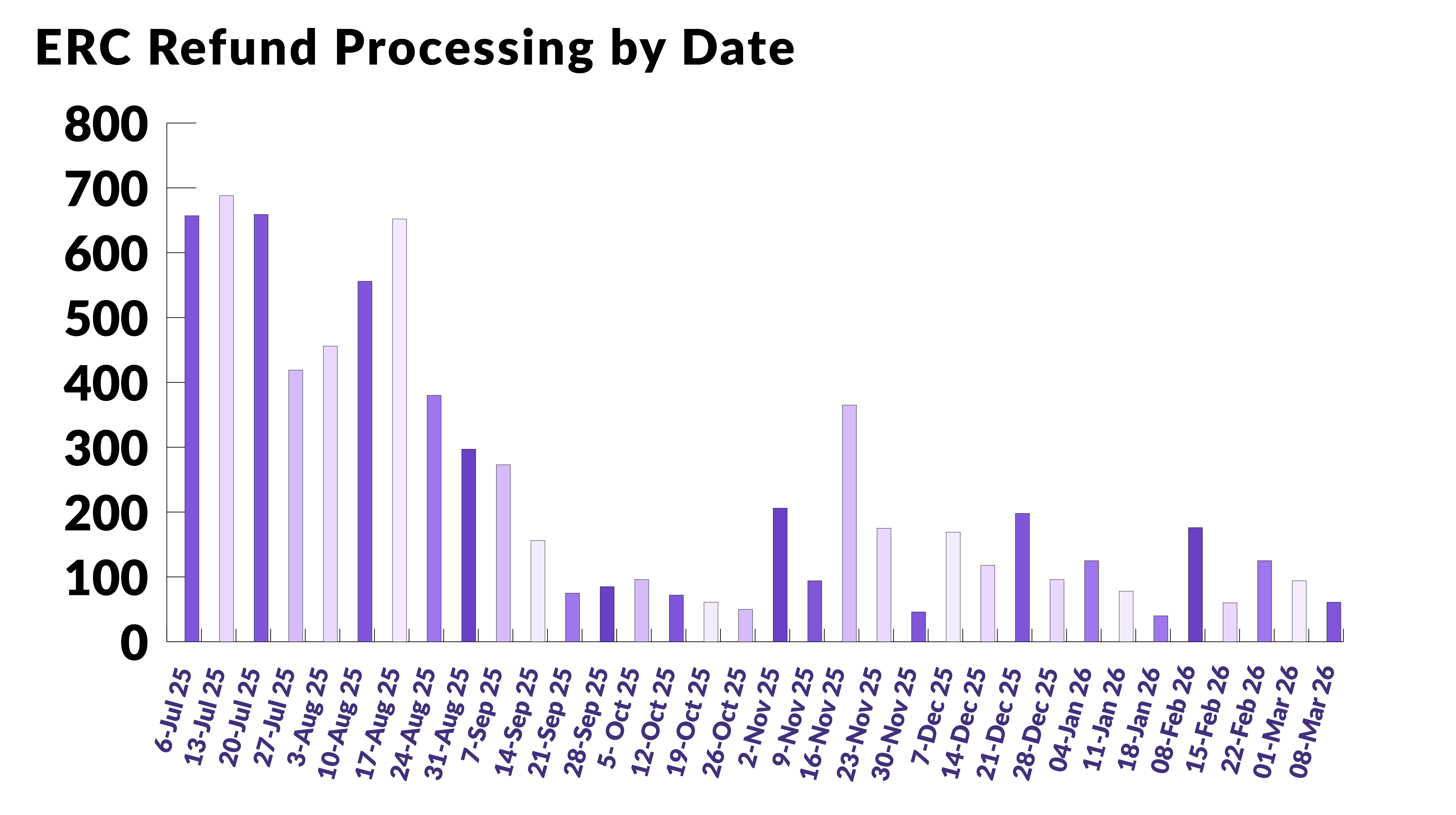
The IRS processed 61 refunds, totaling $14.09M this week. While this confirms that ERC processing has not gone dark, both refund count and dollar volume remain muted compared to earlier this February, but far below historical norms.
Average refund size increased modestly to $230,933, while average days from filing to refund stayed flat at 563 days. That improvement reflects the release of extremely stale claims rather than any meaningful acceleration.
This is movement, but not momentum.
Total refunds: 61, down from 93 last week
Total dollar volume: $14.09M, down from $19.7M
Average refund: $230,933, up from $212,754
Average days from filing to refund: 563 days, flat from the same number of days last week
Denials: 12, down from 21
Audits: 104 total this month, up from 54, but all of the additional 50 are Code 420 to match last week’s Code 424

Audit activity increased again this week, with 50 audit-related codes observed. On paper, that looks aggressive, however, in practice, it is far more restrained.
All of the new codes were Code 420s, largely tied to the same taxpayers and quarters previously flagged under Code 424 last week. We did not observe meaningful expansion into new taxpayers, new quarters, or previously untouched refund populations.
We observed 12 denials this week, several of which appear tied to correspondence audits being closed with zero ERC approved. While still limited, these cases may preview how the IRS intends to resolve the summer and fall 2025 IDR backlog, whether through substantive review, quiet closure, or referral to Appeals.
The most destabilizing aspect of the ERC program today is not enforcement, delay, or even denial.
It is the absence of transparent communication.
The IRS has provided no clear public accounting of:

Instead, taxpayers and practitioners are left to infer policy through transcript codes, sporadic refunds, and quiet denials.
That vacuum breeds confusion, distrust, and unnecessary friction, especially for compliant taxpayers who simply want resolution.
While the ERC system is not frozen, it is operating without a visible endpoint or a communicated path forward.
Until that changes, uncertainty, not enforcement, will remain the program’s defining feature.
Signing off,
Kenny Dettman, CPA
Disclaimer: *𝘋𝘢𝘵𝘢 𝘴𝘦𝘵 𝘪𝘴 𝘧𝘳𝘰𝘮 𝘢𝘱𝘱𝘳𝘰𝘹𝘪𝘮𝘢𝘵𝘦𝘭𝘺 15,000 𝘣𝘶𝘴𝘪𝘯𝘦𝘴𝘴𝘦𝘴 𝘵𝘳𝘢𝘤𝘬𝘪𝘯𝘨 𝘌𝘙𝘊*

