


For much of the last five years, ERC has dominated the conversation around COVID-related tax refunds.
That may be starting to change.
While ERC processing still has a heartbeat, much of the market’s attention appears to be shifting toward a different COVID-era refund opportunity: penalty and interest abatement in the wake of Kwong v. United States.
And candidly, that shift makes sense as this may be the last viable opportunity for both businesses and individuals to soak up remaining “stimulus” opportunities in the extended wake of the economic brutality inflicted by the pandemic.
ERC remains highly valuable, but an increasingly questionable receivable for many businesses. It also remains increasingly complex, inconsistent, and expensive to pursue in appeals or litigation. By contrast, many taxpayers are discovering that COVID-era penalty abatement claims may offer a cleaner, less subjective, and more practical path to IRS refunds.
That does not mean ERC is completely dead. We’ve still got a pulse and a heartbeat.
In fact, this week’s data shows that the IRS continues to work through the same familiar backlog of special-situation claims.
Here’s how this week compares to last week:
Total Refunds: 122 vs. 78 last week(+44 / +56%)
Total Dollar Volume: $14.7M vs. $4.97M last week ( +$9.73M / +196%)
Average Refund: $120,742K vs. $63.7K last week ( +$57K/ +89%)
Denials: 14 vs. 5 las week (+9 / +180%)
Average Days to Refund: 741 vs. 805 last week (-64 days)
Audits (April): 1 new 424 code vs. 0 last week

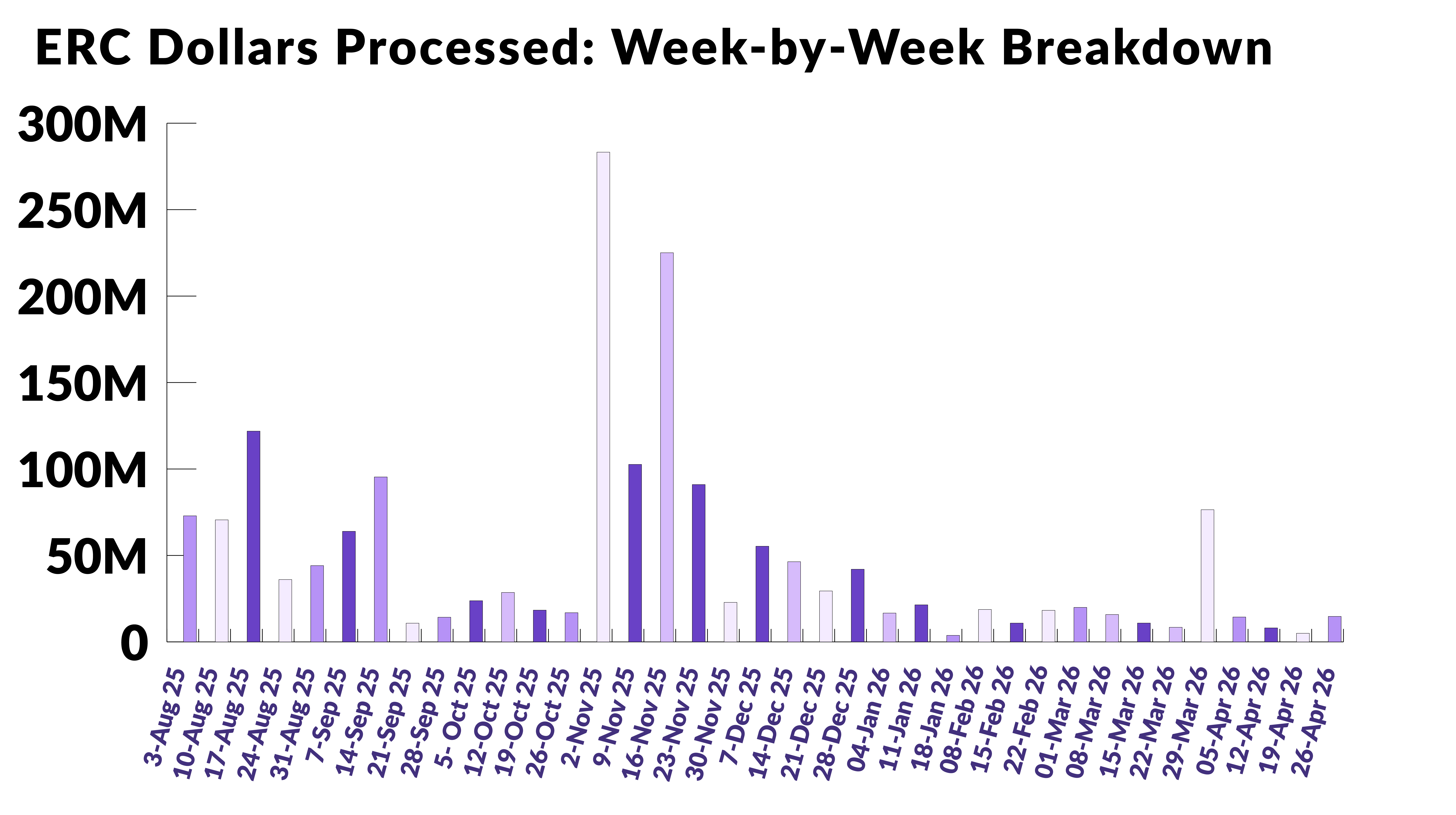
This week’s modest spike in refund volume and average refund size strongly suggests the IRS remains focused on special-situation inventory, rather than broad-based backlog processing, and was also propped up by a single $4 million refund.
We continue to see signs of movement in the same selective buckets:

That is encouraging, but the broader pattern remains unchanged. Refund activity still appears highly selective and tied to edge-case resolution, not systematic processing of remaining ERC inventory.
If I’ve said it once, I’ll say it again:
If you haven’t reviewed your transcripts or called the IRS on every pending ERC that hasn’t already been tagged as a special situation, do it now.
Even with improved ERC activity this week, one thing is becoming increasingly clear. The tax market’s focus is no longer just on ERC or 4/15 deadlines.
More firms, advisors, and taxpayers are now turning their attention to COVID-era penalty and interest refund opportunities, particularly following the growing awareness of Kwong v. United States and related administrative relief arguments.
Why?
Because for many taxpayers:
At TaxNow, we increasingly view COVID-era penalty and interest recovery as the last major underdeveloped frontier of COVID-era refund opportunities.
That is exactly why we launched PenaltyBack.com.
While ERC dominated headlines, millions of taxpayers and businesses quietly paid:
Many of those amounts may now be recoverable.
If ERC represented the first wave of COVID refund opportunities…
Penalty abatement may represent the last meaningful wave.
This week was a stronger ERC week on paper.
Refunds increased. Average refund size nearly doubled. And special-situation processing appears to have improved modestly across several categories.
But the broader takeaway may be less about ERC itself—and more about where the market is heading next.
ERC remains relevant.
Yet increasingly, the smartest practitioners are no longer asking only: “What ERC claims are left?”
They’re asking: “Where else did COVID create refund opportunities that taxpayers have not yet pursued?”
For many, the answer may be PenaltyBack.
Disclaimer: *𝘋𝘢𝘵𝘢 𝘴𝘦𝘵 𝘪𝘴 𝘧𝘳𝘰𝘮 𝘢𝘱𝘱𝘳𝘰𝘹𝘪𝘮𝘢𝘵𝘦𝘭𝘺 15,000 𝘣𝘶𝘴𝘪𝘯𝘦𝘴𝘴𝘦𝘴 𝘵𝘳𝘢𝘤𝘬𝘪𝘯𝘨 𝘌𝘙𝘊*

