


For most of the ERC backlog, the weekly question has been simple: how many refunds went out? This week, that may no longer be the most important question.
Yes, refund volume was down sharply in TaxNow’s data. Yes, we continue to see isolated signs that some previously denied claims may be getting resolved through full or partial settlements. And yes, there are still taxpayers sporadically receiving checks after waiting many, many years.
But the bigger ERC story this week came from IRS.gov.
The IRS recently updated its public ERC page and is now reporting that only 20,600 ERC claims remain in various stages of review, most of which have a slim chance of survival. That number is broken into five buckets: claims under review, claims pending payment or disallowance, claims under audit, claims awaiting review of disallowance responses, and claims with Appeals.
At first glance, that sounds like the ERC backlog is virtually finished, outside of a small number of claims working their way through exams and appeals.
The more alarming interpretation is that many claims taxpayers and processors still believe are “pending” are likely deader than a dornail.
Total Refunds: 49 (vs. 112 — down 63 / -56%)
Total Dollar Volume: $4.3M (vs. $17.2M — down $12.9M / -75%)
Average Refund: $87,927 (vs. $154,182 — down approximately $66K / -43%)
Average Days from Filing to Refund: 723 (vs. 777 — improved by 54 days)
Denials: 3 (vs. 7 — down 57%)
New Audits: 0 in June, although PEO-related examination activity continues to surface anecdotally
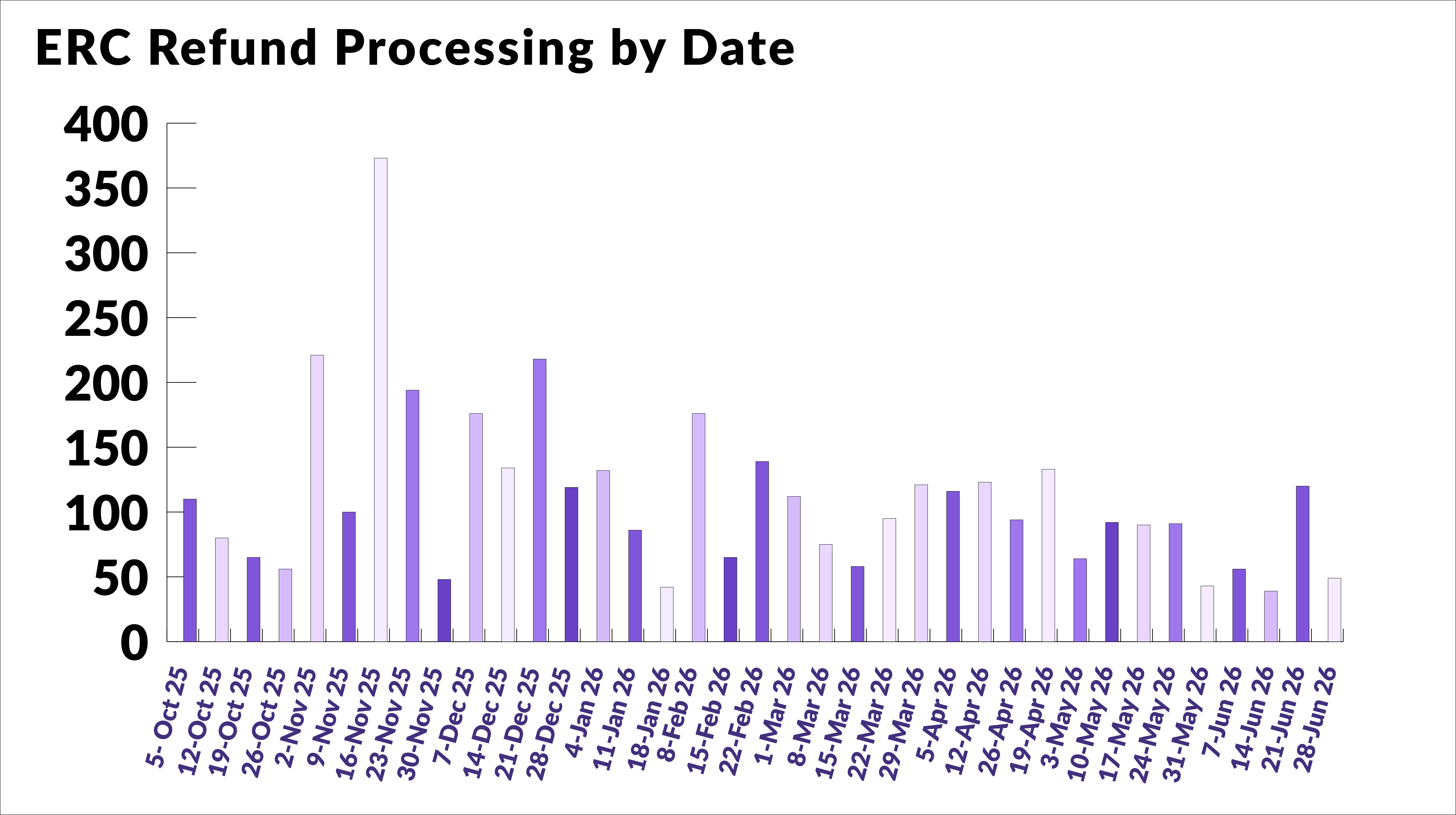
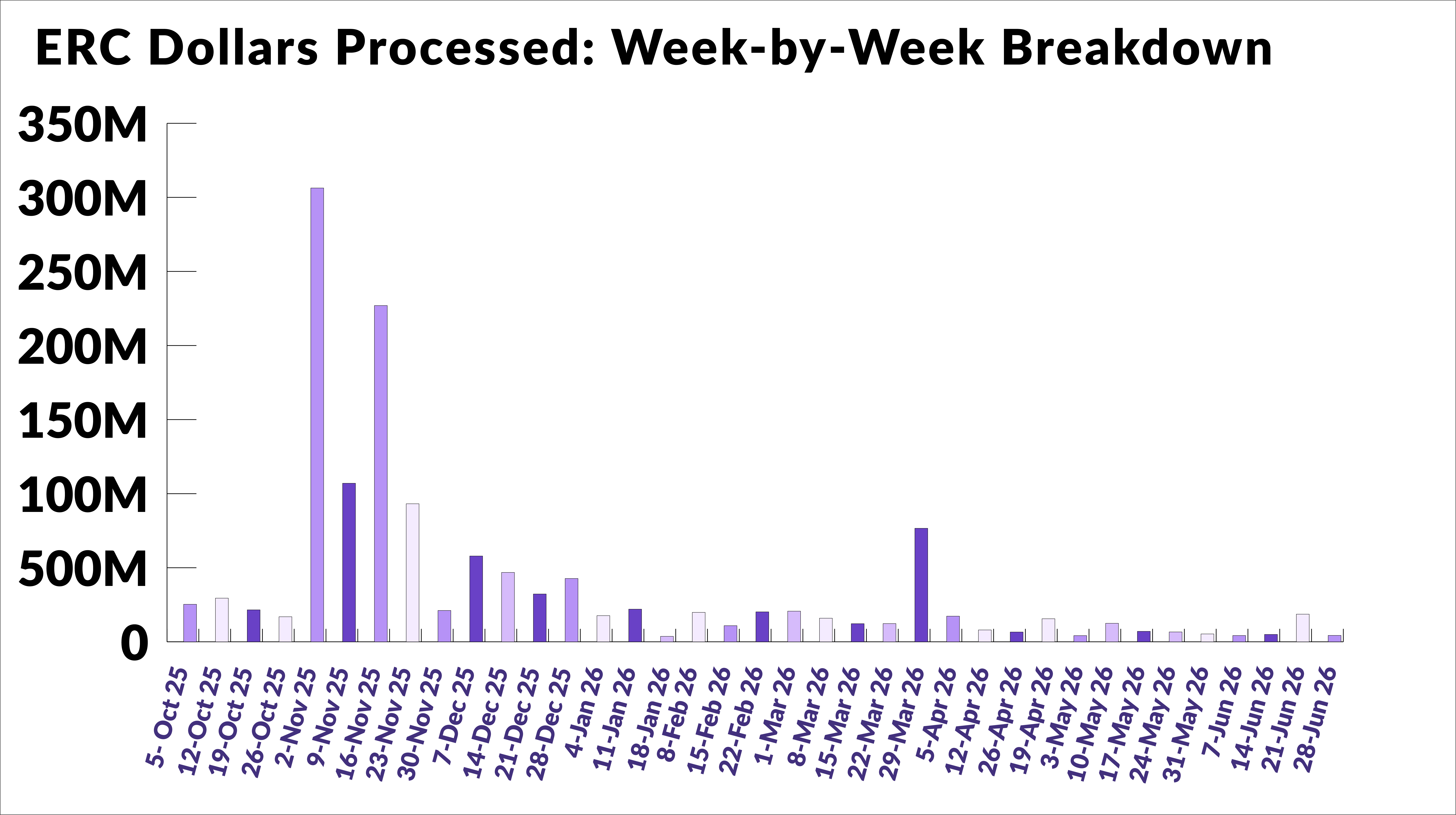
A few months ago, a week with 49 observed refunds and $4.3M in total volume would have been the headline. Today, it feels more like a footnote.
The IRS is now formally telling the public that the remaining ERC universe is extremely small. According to the IRS, only 20,600 claims remain across all major stages of processing, audit, disallowance response review, and Appeals.
That figure is hard to square with what many ERC processors, practitioners, and taxpayers believe they are still seeing. But that does not necessarily mean the IRS count is fabricated or meaningless. It may mean the definition of “remaining claim” has changed.
A taxpayer or processor may think a claim is still alive because no refund was received, no meaningful explanation was provided, and no final practical resolution occurred. But the IRS may view that same claim as already processed, disallowed, closed, routed to compliance, or otherwise removed from the pending refund backlog.
The ERC conversation may be shifting from “When will the IRS pay these claims?” to “How many claims are still actually alive?”
The most concerning possibility is not that the IRS has misstated the statistics. The more concerning possibility is that the statistics are directionally accurate.
If only 20,600 ERC claims remain in the IRS’s published inventory, including PEOs, then a significant number of claims that taxpayers still believe are waiting for action may already have been resolved internally in a way that does not feel like resolution to the taxpayer.
That gap may explain why ERC processors and taxpayers continue to report large unresolved inventories while the IRS reports a much smaller remaining backlog.
The IRS’s ERC statistics also remain difficult to interpret because of PEO claims. We are also continuing to hear of more and more new PEO ERC audits.
A single PEO-filed employment tax return can relate to ERC claims for many underlying businesses. If the IRS is counting at the return or claim level, the published statistics may not fully reflect the number of businesses economically affected by unresolved PEO claims.
That is one reason the headline number may understate the number of taxpayers still waiting for answers. It also helps explain why some parts of the market continue to feel frozen even as the IRS reports that the backlog has largely narrowed. For taxpayers tied to PEO filings, there may be little visibility, limited direct communication, and no easy way to know whether their claim is truly pending, under review, denied, or stuck inside a broader aggregate filing issue.
The IRS’s own breakdown shows that a large portion of the remaining inventory is no longer in ordinary refund processing. According to the IRS, 6,000 claims are awaiting review of disallowance responses and 1,600 are with Appeals. That means thousands of taxpayers are no longer simply waiting for the IRS to process a refund. They are trying to reverse or contest an adverse IRS determination.
For much of the ERC backlog, taxpayers were waiting on processing. Now, many are waiting on dispute resolution. That shift changes everything: timing, documentation, strategy, statute protection, and litigation risk.
There was one positive signal in this week’s data. Several refunds observed this week appear tied to claims that previously received 105-C disallowance notices but were later resolved through actual Appeals settlements (i.e., not via the IRS’ pre-appeals review). The sample size is still small, but the development is worth watching.
This week’s refund numbers were weak, but the bigger development was the IRS’s updated ERC statistics.
If the IRS is right that only 20,600 claims remain across all major stages, the ERC backlog has changed dramatically. But that does not mean the ERC story is over. It may mean the story has moved, once again, from refund processing to claim survival.
Many taxpayers may still believe they are waiting for refunds when, in reality, their claims may have already been disallowed, routed into compliance, tied up in a PEO filing, or moved into a dispute process that requires immediate attention.
That is the uncomfortable message behind the new IRS data.
The focus is no longer just on who gets paid next.
It is on figuring out which claims are still alive at all.
Disclaimer: *𝘋𝘢𝘵𝘢 𝘴𝘦𝘵 𝘪𝘴 𝘧𝘳𝘰𝘮 𝘢𝘱𝘱𝘳𝘰𝘹𝘪𝘮𝘢𝘵𝘦𝘭𝘺 15,000 𝘣𝘶𝘴𝘪𝘯𝘦𝘴𝘴𝘦𝘴 𝘵𝘳𝘢𝘤𝘬𝘪𝘯𝘨 𝘌𝘙𝘊*

