


Over the weekend, we hinted at a major development in ERC processing.
The bottom line? It’s clear:
The IRS appears to have made a substantive push to action all ERC claims, and the backlog (at least for non-PEO filings) may effectively be gone.
Based on TaxNow’s transcript monitoring data and our estimated market coverage, we now believe:
The IRS has likely actioned nearly all non-PEO ERC claims.
That does not mean every taxpayer received a refund. It means your claim has likely been:

If you haven’t already, we strongly recommend reading our latest deep dive:
👉 https://www.taxnow.com/blog/erc-hard-truths-your-erc-claim-may-have-already-been-denied
It explains why many taxpayers may have already had their claims resolved — without realizing it.
This week’s numbers tell the story:
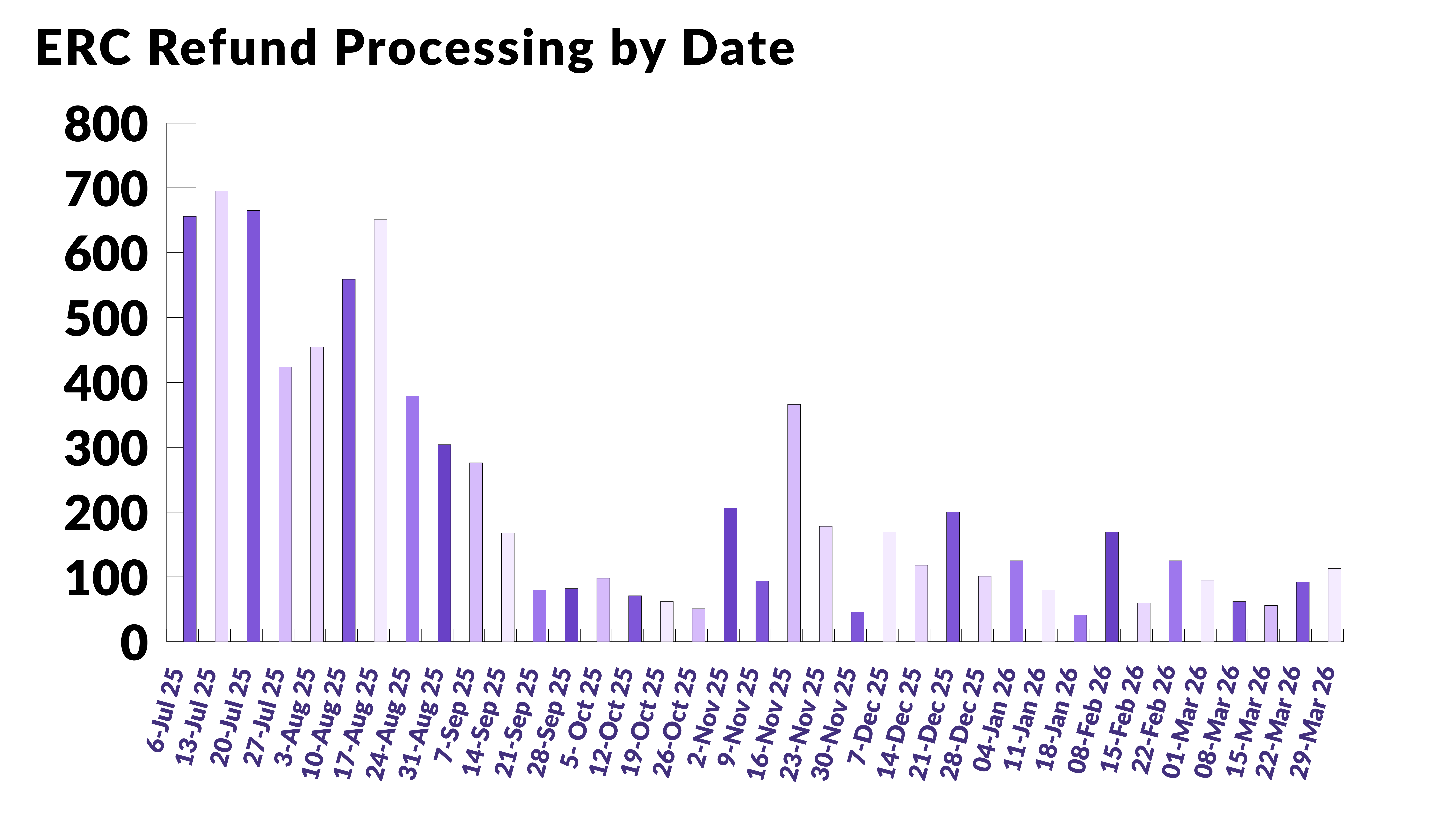
Total Refunds: 115 vs. 91 last week (+24 / +26%)

Total Dollar Volume: $75.72M vs. $8.47M (+794% / ~9x increase)
Average Refund: $670,100 vs. $93,077 (+620%)
Average Days to Refund: 602 vs. 850 (↓ 248 days / -29% faster)
Denials: 14 vs. 5 (+9) (Not a focus area, but directionally increasing alongside processing activity)
Audits (March): 3 vs. 0 (Still low overall, but now appearing as processing accelerates) The headline is clear:
Refund dollar volume jumped nearly 10x week-over-week.
Last week’s total dollar volume was just $8.47M. This week’s spike strongly supports the conclusion that the IRS executed a coordinated processing push.
Notably, these refunds appear to be primarily “plain vanilla” claims, filings that had simply been sitting in processing purgatory.
Last week, we noted that activity was increasingly tied to:
This week looks fundamentally different.
The magnitude and composition of refunds suggest a coordinated release of larger, long-pending normal-course refunds.
The nearly 10x increase in dollar volume, combined with:
…strongly supports the conclusion that the IRS may have executed a broad clearing event, rather than incremental cleanup.
This is a critical distinction:
In other words: The IRS didn’t just “pay everyone.” It cleared the board.
That aligns with what we outlined in our recent “Hard Truths” post — that the ERC lifecycle has shifted from waiting to outcomes.
One major caveat remains:
We still lack sufficient visibility into PEO-filed claims.
With that said, based on IRS messaging, we expect PEO refunds to begin rolling in soon.
This will likely play out over the next several weeks to months as those systems catch up.
Bottom line: We may not be fully “done,” but we are likely in the final chapter of ERC processing.
One of the more encouraging developments:
We are seeing early indications that both Taxpayer Advocate Service (TAS) and the IRS are working toward streamlined processes for accepting Form 907 filings.
This is particularly important for taxpayers who:
If this holds, it could provide a much-needed procedural path forward for taxpayers who otherwise risk being time-barred.
We are also seeing movement on ERC examinations. That’s the good news.
The bad news: Closed exams are, so far, resulting in full denials.
From a transcript perspective, watch for:
If you see both, your exam is likely complete, and you should expect follow-on correspondence, including a 105C denial letter.
If you filed an ERC claim and are still waiting:
1. Check your transcripts immediately. Your claim may already be resolved, even if you haven’t received a check or letter.
2. Look for key indicators:
3. Evaluate your next move:
We may be entering the final phase of ERC processing. After years of delays and uncertainty, recent activity suggests the IRS has begun systematically working through the remaining claims. For many taxpayers, this means clarity is arriving, whether in the form of a refund, a denial, or further review in examination. At this stage, the most important step is staying informed and proactive, as the window to respond to certain outcomes may be limited.
Disclaimer: *𝘋𝘢𝘵𝘢 𝘴𝘦𝘵 𝘪𝘴 𝘧𝘳𝘰𝘮 𝘢𝘱𝘱𝘳𝘰𝘹𝘪𝘮𝘢𝘵𝘦𝘭𝘺 15,000 𝘣𝘶𝘴𝘪𝘯𝘦𝘴𝘴𝘦𝘴 𝘵𝘳𝘢𝘤𝘬𝘪𝘯𝘨 𝘌𝘙𝘊*

